Never Miss an Update.

Explore Recent Editions

The Way Ahead on Debt: Reform, Resilience, and Leadership in a Fragmented World
February 18, 2026
Debt sustainability has re-emerged as a central fault line in the global economy, shaped by rising interest rates, slowing growth, climate shocks, and an increasingly fragmented geoeconomic landscape. Strategic competition, weakened multilateral cooperation, and diverging creditor interests have made coordinated solutions more difficult, even as debt vulnerabilities across the Global South continue to deepen. At the same time, borrower countries have become more assertive and coordinated, placing debt reform firmly on the agenda across the G20, the financing for development process, and the climate negotiations.
Against this backdrop, the webinar organized by the Debt Relief for a Green and Inclusive Recovery (DRGR) Project will look ahead to the next phase of global debt reform. It will explore how emerging and more inclusive spaces—particularly within the United Nations and the follow-up processes of the Fourth International Conference on Financing for Development, including the Borrower Platform and the Seville Forum on Debt—can help overcome fragmentation, align incentives among diverse actors, and translate momentum into delivery.
The G20 Leaders’ Summit and COP30: Navigating Fragmentation, Advancing Coalitions, and Keeping Debt on the Global Agenda
November 27, 2025
The G20 Leaders’ Summit in Johannesburg and COP30 in Belém took place at a moment of acute strain on the multilateral system. Geopolitical divisions widened, major powers resisted deeper reforms, and petrostates blocked progress on fossil-fuel phaseout. Yet across both summits, coalitions of the willing pushed forward—keeping debt sustainability, climate ambition, and inclusive development high on the global agenda.
Over the year South Africa used its G20 presidency to place debt sustainability high on the agenda. The release of the Africa Expert Panel Report marked a significant milestone: African policymakers set out a borrower-led agenda for reform, calling for a refinancing initiative, a Borrowers’ Club, and stronger debt-resolution mechanisms. While the leaders’ communiqué stopped short of major breakthroughs, it reaffirmed commitments to debt sustainability and climate resilience, and highlighted the high cost of capital facing vulnerable economies.
At COP30, early momentum collided with familiar political red lines, especially on fossil-fuel phaseout. But negotiators still produced a meaningful package: tripled adaptation finance by 2035, a Just Transition Mechanism, and new climate-finance workstreams. And although the Baku–Belém Roadmap was merely “noted,” it spotlighted a truth that can no longer be sidelined: climate ambition is inseparable from fixing the debt and financing pressures constraining developing economies.

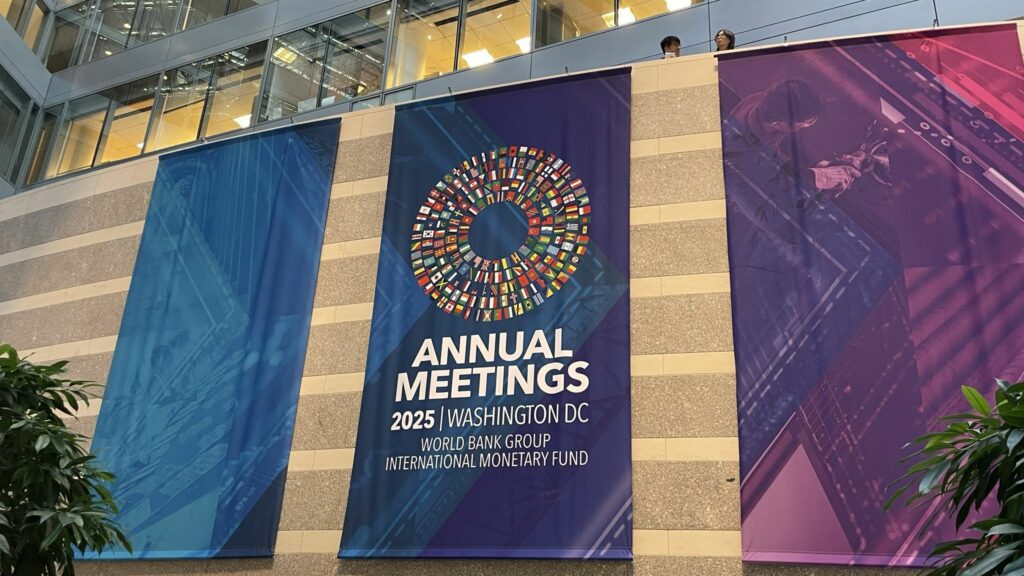
Recognition Rising, Reform Pending: Insights from the 2025 IMF/World Bank Annual Meetings
October 24, 2025
The 2025 Annual Meetings of the IMF and World Bank Group took place against a backdrop of heightened global uncertainty. While recent data from the IMF suggests the world economy has shown resilience, this stability remains untested—and future shocks, from climate disruptions to trade tensions, loom large.
The numbers tell a sobering story: Inflation remains elevated, interest rates stubbornly high, and debt vulnerabilities widespread. While low-income countries may face declining debt levels—not because of progress, but because they lack access to finance altogether. Debt service remains at records level, squeezing fiscal space for critical investments in climate action and development.
The meetings highlighted a growing consensus: The global debt crisis is not just a financial issue—it’s a development emergency. Economists, civil society organizations, and policymakers alike demanded meaningful debt reform. Behind closed doors, officials increasingly recognize that countries are “defaulting on development”—failing to provide basic goods and services due to crippling debt burdens.
DRGR Round Up: 2025 IMF/World Bank Annual Meetings
October 14, 2025
As the 2025 Annual Meetings of the International Monetary Fund (IMF) and the World Bank unfold this week, anticipation and uncertainty are running high. Mounting criticism and political pressure — particularly from the United States — have led to a debate about the mandate of the Bretton Woods institutions, with calls to scale back their climate focus in favor of traditional economic stabilization roles.
At the same time, questions of fairness and consistency are resurfacing. The substantial support extended by the IMF and the U.S. Treasury to Argentina under President Milei stands in sharp contrast to the limited assistance offered to other heavily indebted countries still struggling to manage their crises alone.
These dynamics highlight deepening unease about the state of multilateralism and the ability of international financial institutions to respond equitably and effectively to the worsening debt distress across Emerging Markets and Developing Economies (EMDEs). Recent research from the DRGR Project has focused on the regions most exposed to this crisis: Latin America and the Caribbean (LAC), Asia and the Pacific, and Africa.